

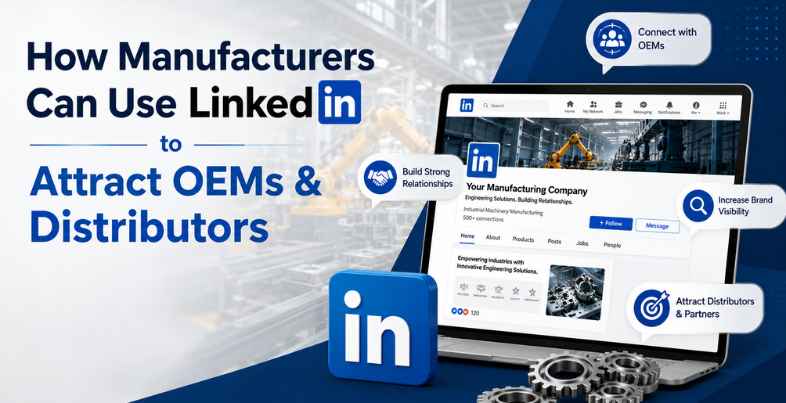
LinkedIn is not just a platform that brings together manufacturing companies for networking purposes. It has also become one of the most effective methods for connecting with OEMs, distributors, procurement officers, and other decision-makers in a B2B setting.
In contrast to several other social networking websites, LinkedIn has been designed for making professional connections. If used correctly, LinkedIn allows manufacturers to build their reputations and form business connections.
1. Optimise Your LinkedIn Company Page for B2B Buyers
The LinkedIn company page is the first place an OEM/distributor looks before contacting you.
- Ensure that your page quickly answers these questions:
- What do you make?
- What can you do?
- Who do you serve?
Avoid saying things like “a leading manufacturer of quality products,” since they lack specificity. Mention what manufacturing capabilities, capacity, and certification you have, the industries that you cater to, and the countries where you export.
A well-written profile makes you trustworthy before even having a single conversation.
2. Develop Content Around the Issues of Procurement
OEMs and distributors are not just interested in finding something interesting to read on your website. They are looking for dependable suppliers who know what problems they face in their business.
Develop content on issues related to procurement and sourcing like:
- Product quality and quality control
- Manufacturing capacity
- Delivery time
- Certification and compliance
- Export capabilities
- Supply chain management
- Product development
- Production facilities and equipment
The type of content like case studies, facility updates, product demos, and technical insights is especially useful since it shows your capabilities instead of just stating them.
3. Use LinkedIn Search to Find the Right People
Probably the best feature of LinkedIn for a B2B manufacturing business is the ability to find relevant people.
Rather than waiting for potential customers to find you, actively look for those who make decisions on procuring your products.
Look for job titles such as:
- Procurement Manager
- Purchase Manager
- Sourcing Manager
- Supply Chain Director
- Category Manager
- Strategic Sourcing Manager
- Business Development Manager
You can also limit your search by industry, company size, location, and company name.
4. Develop a Relationship before Pitching
One of the most common mistakes OEMs and distributors make on LinkedIn is pitching immediately after connecting.
Companies get numerous similar messages from suppliers. They simply ignore all those.
First, you need to develop relationships.
Pitch when you are well-known.
Follow them on the platform and their key decision makers. Comment on the relevant posts. Provide some industry insights. Be aware of what they focus on.
When you finally send a connection request or a message, make sure it is relevant and personalised.
For instance, instead of:
“We are a leading manufacturer. Please let us know if you have any requirements.”
Use:
We see that you sell a product in our category. Do you have any requirements?”
The main idea is to be a relevant industry contact before being a supplier.
5. Highlight Certifications, Manufacturing Capabilities & Expertise
Trust is crucial for OEMs and distributors.
They have to be sure that you will always be able to provide the expected quality, quantity, compliance and reliability of the product.
Showcase on LinkedIn:
- ISO and other necessary certifications
- Plant audits
- Quality control systems
- Production capabilities
- Manufacturing infrastructure
- Exporting experience
- Modern machinery and technologies
- Projects and successes with clients
- Testing and compliance
Certifications on your website aren’t enough anymore. Make sure to turn every milestone into LinkedIn content.
Each factory renovation, certification, plant audit, or production success provides one more reason for a potential client to believe in your business.
6. Leverage Employee Advocacy to Grow Your Brand
Your company page is not the only component of your LinkedIn marketing strategy.
Your engineers, sales people, operations, business and other key people from your team can also make your brand more visible.
For example, your:
- Engineering team can post technical information
- Sales team can share about customer pains
- Operations team can present manufacturing capabilities
- Leadership team can speak on industry issues
Employee-generated content may be able to reach professional networks that your company page cannot access.
This will provide you with a more authentic brand experience and exposure to your target customers, prospects, OEMs, and distributors.
Turn LinkedIn into a Lead Generation Channel for Your B2B Business
Don’t treat LinkedIn as an outlet where you publish your content sporadically and hope for some inquiries.
An effective B2B strategy on LinkedIn involves the following elements – company page, relevant content, targeted prospecting, relationship building, credibility, and employee advocacy.
Your goal is not to sell to everybody.
Your goal is to repeatedly expose yourself to the right OEMs, distributors, procurement people, and decision makers and gain their trust in order to start a dialogue.
With a consistent approach, LinkedIn can prove to be a valuable channel for your B2B business.